
POLARITY BETWEEN THE USA AND IRAN
Frederik Huysamen, Elmarie Malek & Linda Stroebel
Analytical Typology Jungian Scholar Group
In Analytical Psychology the term “polarity” carries an energy value. Polarity refers to opposing psychological tendencies or attitudes between two poles and the psychic tension that it creates. When the effect of the opposing tendencies becomes pronounced, related symptoms manifest. Examples of such symptoms are stress, anxiety and neuroses. The more intense the opposition between the poles develops, the more the tension mounts and the more pronounced the symptoms become.
The phenomenon of polarity is not limited to personal experiences but is also a factor in interpersonal relations. This fact becomes evident for example in the misunderstanding and discord between people. Furthermore, polarity becomes collective when the representatives of two opposing standpoints have gained adherents. An example of such a polarity is Zionism and Anti-Zionism. A polarity on the collective level produces all kinds of symptoms that correspond to the peculiar collective nature of the respective poles.
The war in the Middle East demonstrates Jung’s concept of polarity on the collective level. Many polarities are observable in this war. We are therefore compelled to limit our reflection to the tension between the USA as aggressor and Iran as defender. We must consequently reserve all other points of view for later reflections, such as those concerning Israel, the Gulf States, the West, the East, etc.
America demonstrates an increasing appetite for seizing and controlling assets in territories that belong to other nations. Iran is currently the target in America’s crosshairs. It is a war of choice, launched without congressional authorization and lacking all legal justification. America’s current military and diplomatic objectives are to seize control over the Strait of Hormuz and of Iranian oil in an attempt to rescue the petrodollar by maximizing its reach and vitality.
Iran is facing an existential threat from the USA. America demands Iran to surrender unconditionally. The choice is to submit sovereignty or be obliterated. Iranians are literally fighting for their survival. For Iran, exercising control over the Strait of Hormuz has become a non-negotiable condition for their security. It furthermore gives Iran leverage to ensure compensation for war damages and reparations.
How do we demonstrate the psychological polarity between America and Iran in the war? One way is to identify the most striking polarity and to measure the tension between the said poles. Prominent in the self-representations of Washington and Tehran is the marked difference in moral intentionality and tone. What then, can we ask, is the moral base that respectively constitutes Washington and Tehran’s executive power?
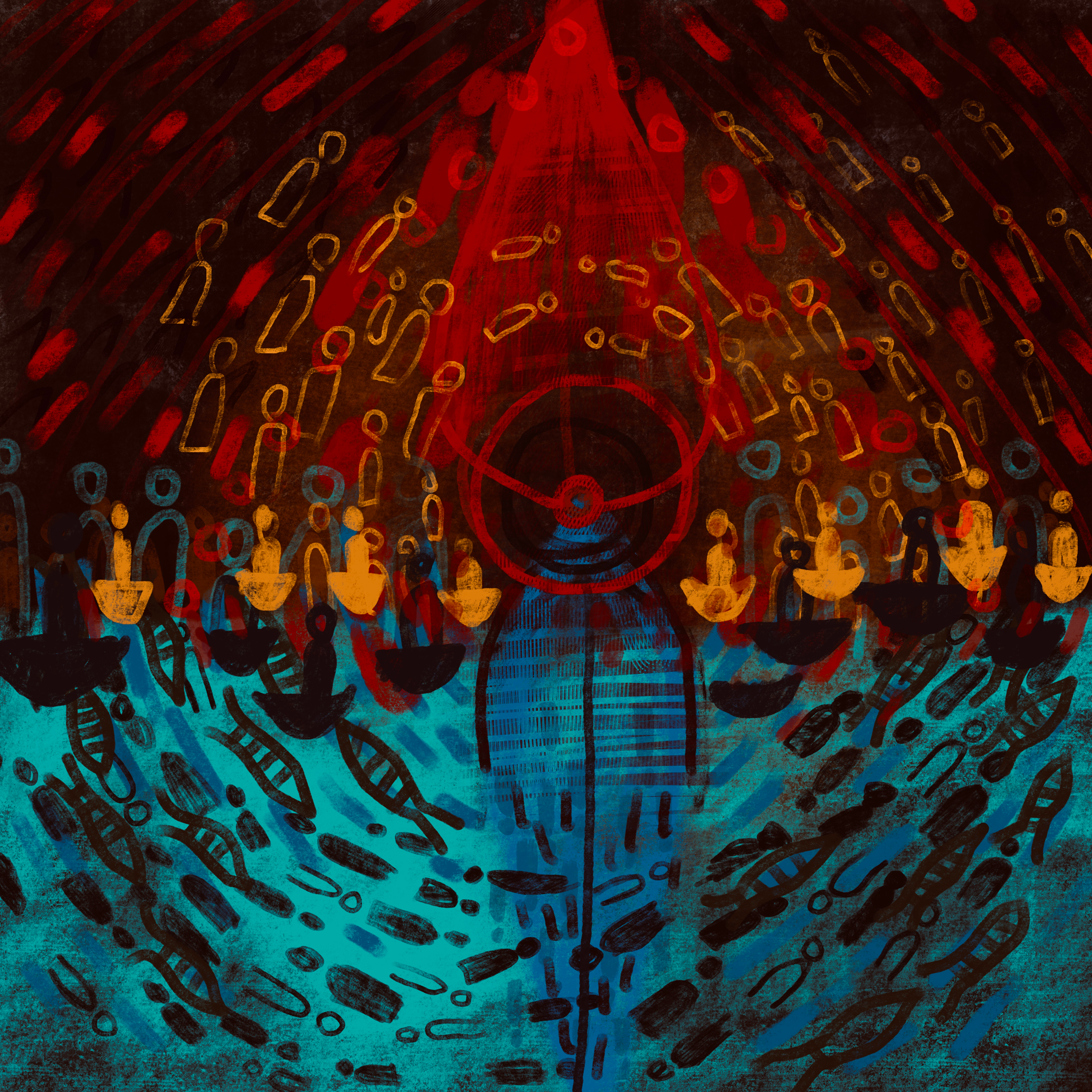
Executive power in the United States is vested in the President. Think of the United States’ governance-model in terms of a triangle, resting on its horizontal base and tapering upward to a single pinnacle representing the Presidential office in the White House. Katie Rogers of the New York Times asked President Trump on 9 January 2026: “Do you see any checks on your power on the world stage? Is there anything that can stop you if you wanted to?” Note the peculiar last part of her question, namely, “if you wanted to.” President Trump answered by saying: “My own morality, my own mind. It’s the only thing that can stop me.” It is equivalent to saying, “What I decide, goes!”
The onset of the war on 28 February 2026 demonstrates the condition and effect of President Trump’s peculiar moral orientation in a gruesome way. Already on day one of the war, an American Tomahawk missile struck a school in Minab, tragically killing more than 160 children. The circumstances point to conscious intent. Since then, the campaign has impacted hundreds of civilian sites, including medical facilities and educational buildings throughout Iran. By 7 April 2026, President Trump issued a stark ultimatum: Iran must reopen the Strait of Hormuz for the U.S. and its allies or face “total destruction.” He also threatened to bomb the nation of Iran back into the “Stone Ages.” His rhetoric often indicates his peculiar moral framework that permits the use of overwhelming force.
President Trump’s peculiar moral orientation is a decisive factor for America’s conduct in this war. It is irrelevant to what extent he acts as a proxy for a more powerful determinant. His executive orders are authoritative and final. He controls America. Whatever he decides has actual effect. He demonstrates a strong “Machiavellian” attitude in this war against Iran. Two idiomatic expressions come to mind, namely, “gaming the system” and “stacking the deck.” President Trump’s skilfulness in shape-shifting reminds us of Loki in Nordic mythology. The United States’ presidency has become virtually dictatorial.
President Trump is in power at a time in history that America is fighting to maintain its global hegemony. America does not fight – like the Iranians do – for the survival of their civilization. America is a nation-state. It is The Sovereign World Empire in terms of the global financial system. It uses sanctions and tariffs to exert economic pressure. It leverages global markets to influence geopolitical outcomes. For example, the U.S. Treasury triggered a severe financial crisis in Iran and, by so doing, succeeded in collapsing a major Iranian bank just before the onset of the war. This formed part of a broader U.S. effort to compel Iranian compliance through maximum pressure. President Trump has clearly changed the rules of engagement. We see America’s willingness to go “Machiavellian” in its attempt to secure the god-almighty-dollar, the image of America’s power in the world. No holds barred, America is fighting to prevail as the Sovereign Dollar Empire of the world, where neither law, nor trust, but power rules. This is excess in its most distilled form.
By contrast, Iran is a civilizational state. It is the latest iteration – the direct, continuous and sovereign embodiment – of ancient Persia. Periods of fragmentation are simply viewed as historical anomalies. Sovereignty for Iran includes territorial integrity but also cultural, moral, and political sovereignty. The Iranians have an immensely rich cultural tapestry carried by their civilizational identity. The state presents itself as the political continuation of the Persian civilization. Think of a civilizational governance-model as circular, where all institutions revolve around the Leader at the centre. The Supreme Leader of Iran, Mojtaba Khamenei, leads from the centre of the Iranian civilizational state, so to speak.
The Supreme Leader Mojtaba Khamenei’s moral orientation is a decisive factor for Iran’s conduct in this war. To become the Supreme Leader of Iran, one must possess unwavering moral integrity. The base of the Supreme Leader’s moral framework transcends religiosity, reflecting also the collective consciousness and vital energy of an entire civilization. We see for instance that Iran does not target civilians deliberately. Iran even discloses targets in advance whenever civilians are at risk. They are decisive and consistent and demonstrate a high level of professional integrity and a remarkable degree of restraint.
President Trump’s worldview represents the foundation of America's moral compass. His conscience is normative in America's war of aggression against Iran. The Supreme Leader of Iran, Mojtaba Khamenei, represents the foundation of Iran's moral compass. His principled morality is founded on the cultivated collective consciousness of a civilization. Given the nuclear tension between the opposite moral frameworks of the USA and Iran, it is evident that rapport and agreement through mere diplomacy are clearly beyond the limits of possibility.
Analytical Psychology provides a viewpoint that leads beyond the limits of standard political and military analysis.
