

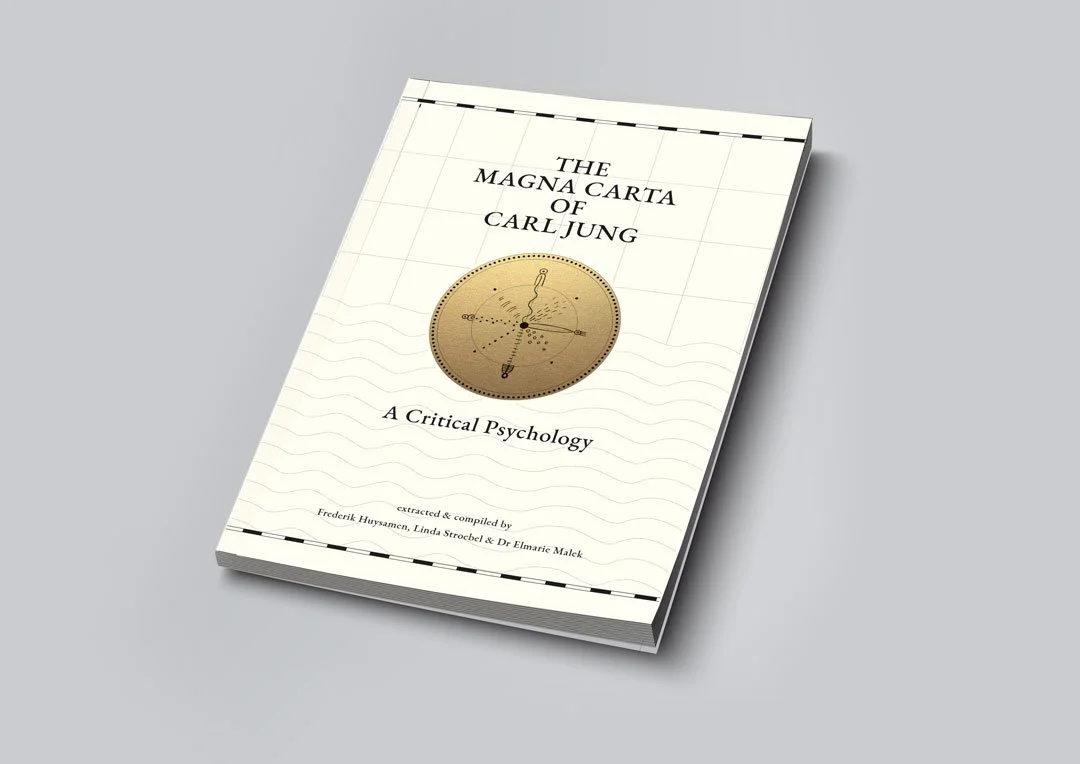
The new revised edition of
The Magna Carta
of Carl Jung:
A CRiTICAL PSYCHOLOGY
Globally available through major outlets.
Extracted and compiled by
Frederik Huysamen, Linda Stroebel and
Dr. Elmarie Malek
The Magna Carta of Carl Jung: A Critical Psychology presents Carl Jung’s empirical discoveries of the different decision-making functions of consciousness. Psychological Types is the first and only purely psychological work and theory ever developed on decision-making. Jung analyses and classifies the formation of the empirical material of individuals when actively engaged in decision-making and which is observable in their verbal and written self-representations. The Magna Carta of Carl Jung presents Carl Jung’s concepts in a narrative format in his own words, accessible to students, the educated layperson who wrestles with self-knowledge, and the specialist. It is a meticulously considered extraction and compilation of Jung’s purely psychological approach to and empirical discoveries regarding decision-making. The Magna Carta of Carl Jung is an indispensable guide to Jung’s Psychological Types.
SHORT EXCERPT FROM SECTION 1
Mind and body
01 (1933, p. 85)
The distinction between mind and body is an artificial dichotomy, a discrimination which is unquestionably based far more on the peculiarity of intellectual understanding than on the nature of things. §916
02 (1933, p. 85)
The continuity of nature knows nothing of those antithetical distinctions which the human intellect is forced to set up as aids to understanding. §915
03 (1971)
Somewhere the psyche is living body, and the living body is animated matter; somehow and somewhere there is an undiscoverable unity of psyche and body which would need investigating. psychically as well as physically; in other words, this unity must be as dependent on the body as it is on the psyche so far as the investigator is concerned. §961
04 (1933, p. 85)………………….
